Organised campaigns spreading misinformation and misusing social media platforms have incentivised pro-Assad fugitives and armed groups to create chaos in the Alawi-majority Syrian coast, resulting in the deaths of hundreds of civilians.
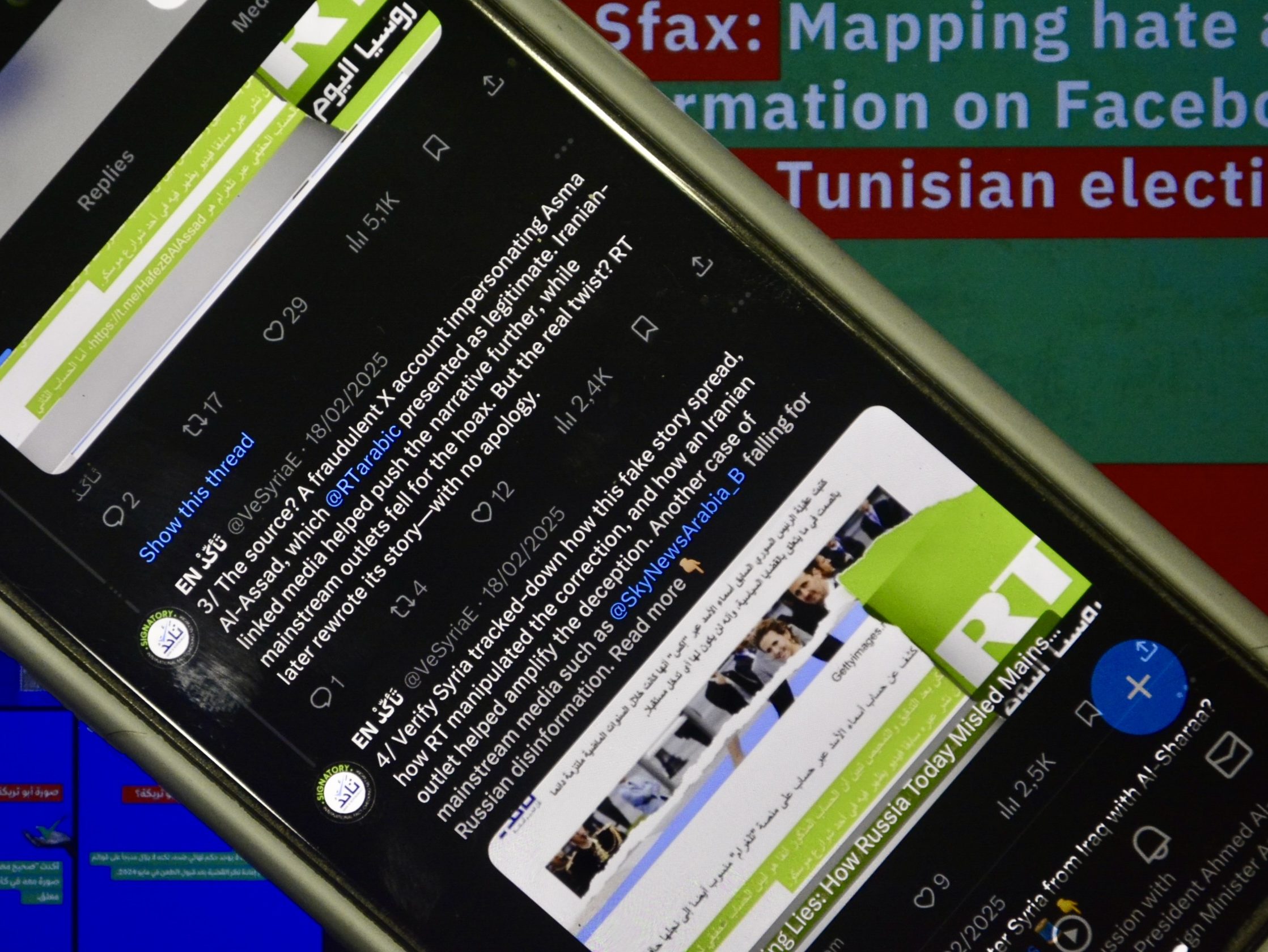
Arabic and international news sites contribute to spreading fake news, leading to riots in Syria (Photo by Harun al-Aswad).
On a dark night in late January, gunmen attacked a military checkpoint in Latakia city on the Syrian coast, sparking chaos and resulting in three deaths and several injuries.
The assailants were not organised; they were entirely driven by fake news flooding social media since the fall of the five-decade-long Syrian regime in late 2024 during a rebel offensive.
The news claimed that Russia, Saudi Arabia, and Syria had made a deal to hand control of the coast to the former president’s brother and was published on Telegram by Noor Halabi, a Germany-based Syrian influencer.
Although he clarified within minutes that he was joking, social media users, including a former official, reposted the claim, adding assertions that parachuting fighters were landing, and Russian jets were hovering over the area to protect the deal.
Related story:
Syria’s Sharaa vows
accountability over coastal
region violence
Read More »
As a result, thousands on the western coast—home to ousted president Bashar al-Assad and his Alawite Islamic sect loyalists, including armed supporters—gathered to celebrate and await Assad’s brother’s arrival.
“Among them some outlaw members took advantage of fake news and attacked our forces. Three assailants were killed, and we are pursuing the others,” the head of Security Forces in Latakia told state media.
Security forces launched a long-term operation in the area, leading to a series of tensions between the two sides, which escalated violently in early March, killing around 1,300 people, including 750 civilians, according to the UK-based Syrian Observatory for Human Rights.
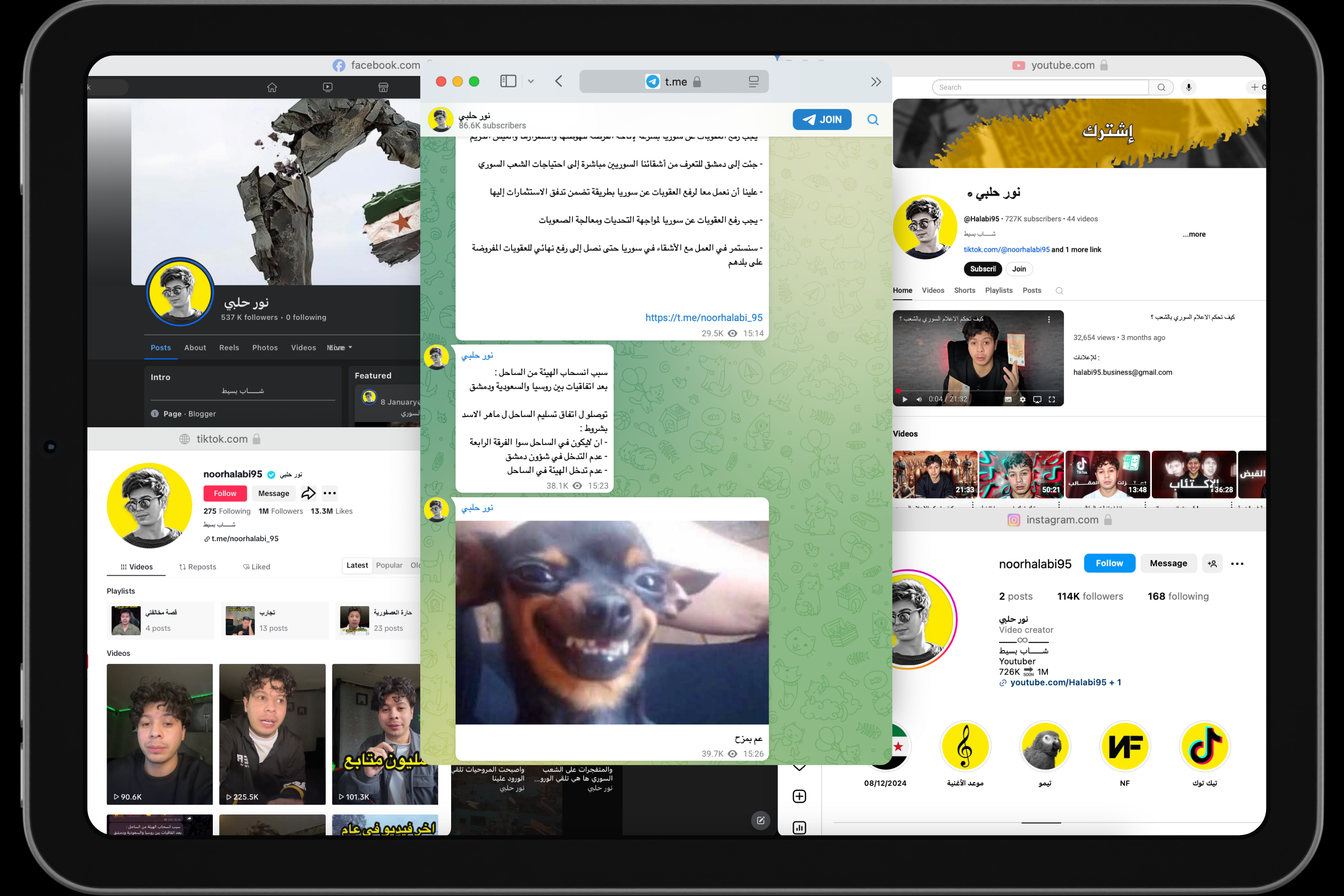
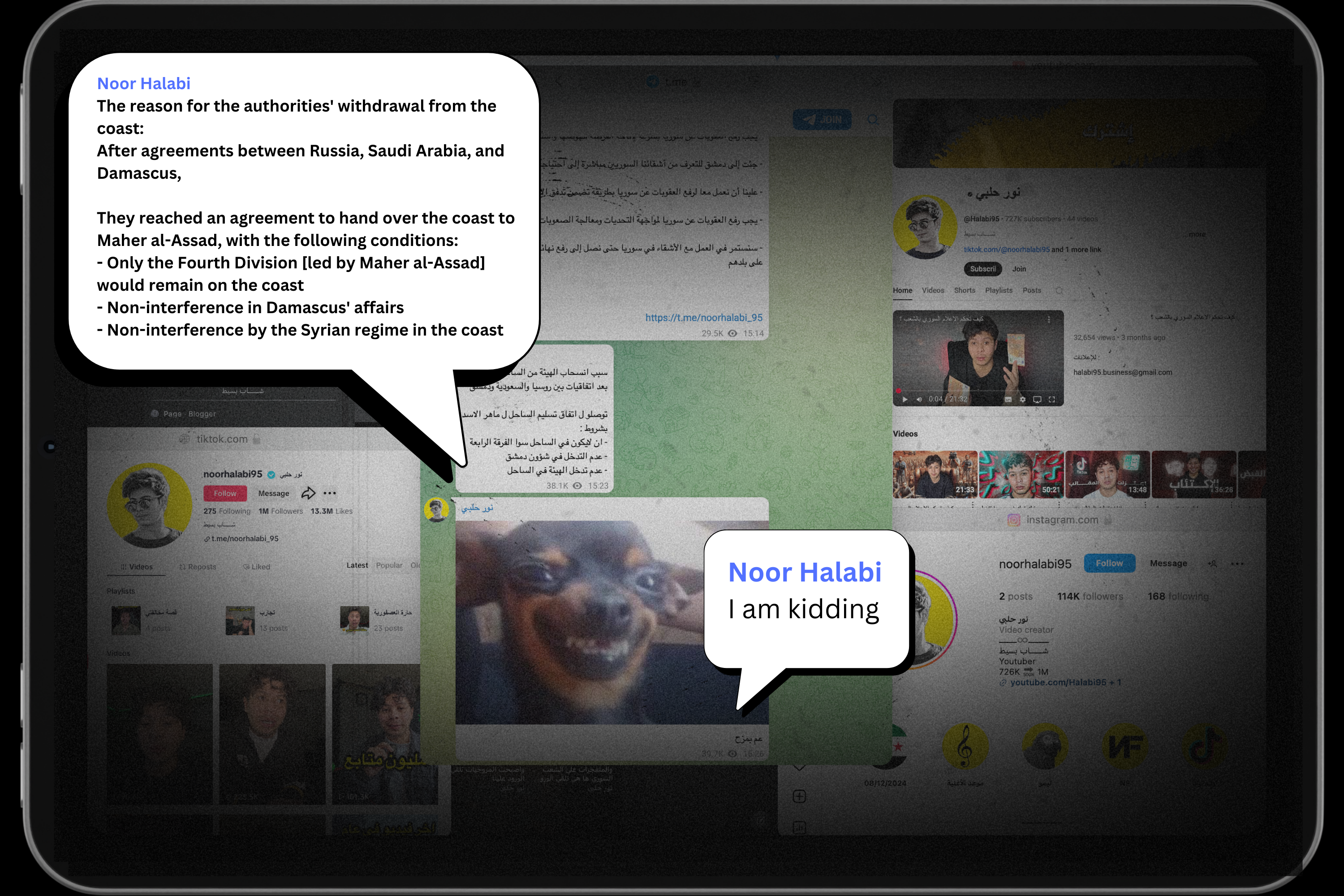
Noor Halabi’s social media accounts, including his Telegram account where he published the fake news. Swipe the handle in the middle of the photo to read the translation. (All designs and graphics by Harun al-Aswad).
“We are concerned that the significant spike in hate speech and misinformation risks further inflaming tensions and damaging social cohesion in Syrian society,” the UN Spokesperson for the UN High Commissioner for Human Rights said.
Organised campaign
Halabi told Middle East Eye that he published the rumours to mislead former regime loyalists who regularly spread misinformation and to expose how they take news from his
“I am a social media creator…
My accounts on media platforms
publish news for people, as
people in Syria before the fall
of the regime did not have [free]
media because it was banned.”
– Noor Halabi, a Germany-based
Syrian influencer.
Social media users praised Halabi’s disinformation, claiming it helped expose Assad regime members. Others argued it compromised national security and the democratic process.
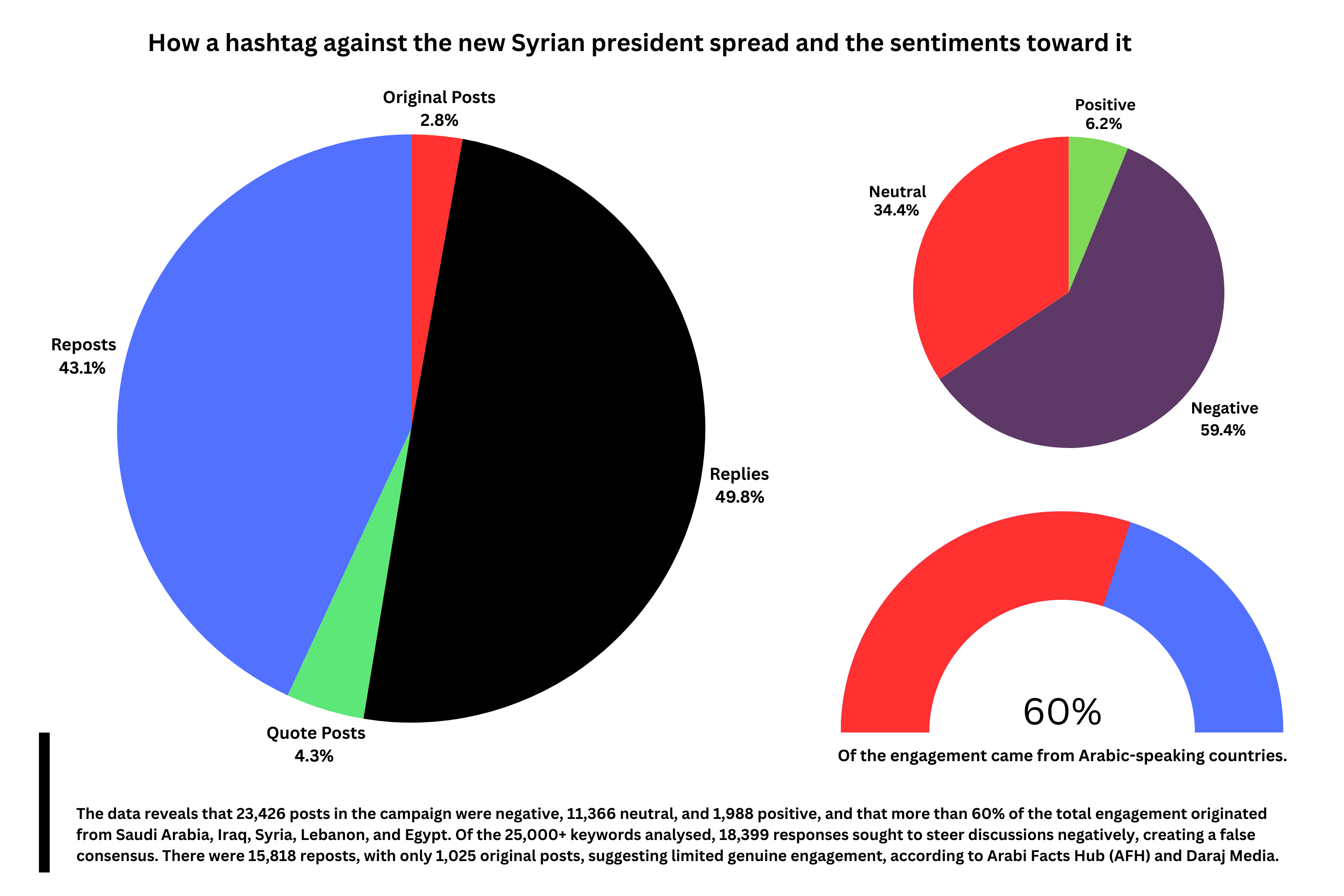
The Middle East-based Arabi Facts Hub and Daraj Media found, that 217,000 posts on X received 115 million views and 1.4 million interactions, fuelling sectarian tensions against Alawites.
The platforms also identified an offensive hashtag against the Syrian president, generated by accounts from five Arabic countries, with a similar theme.
“I did not expect any sensible person to believe such news, and I can assure you that nobody has died because of it,” Halabi said.
“I am a social media creator… My accounts on media platforms publish news for people, as people in Syria before the fall of the regime did not have [free] media because it was banned.”
Halabi said he does not profit financially from his work and sources news from TV channels such as Al Arabiya and social media, then “simplifies” it to make it more accessible.
However, the Saudi-based Al Arabiya TV, its subsidiary channel Al-Hadath, and the Arabic versions of Sky News and CNBC TV, which are based in the UAE, have recently published numerous unverified reports.
Al-Hadath, reported that a mass grave containing more than a thousand people killed by Assad’s security forces was discovered. However, the main source, Reuters, had merely analysed over a thousand dea ths under Assad but did not confirm a new mass grave.
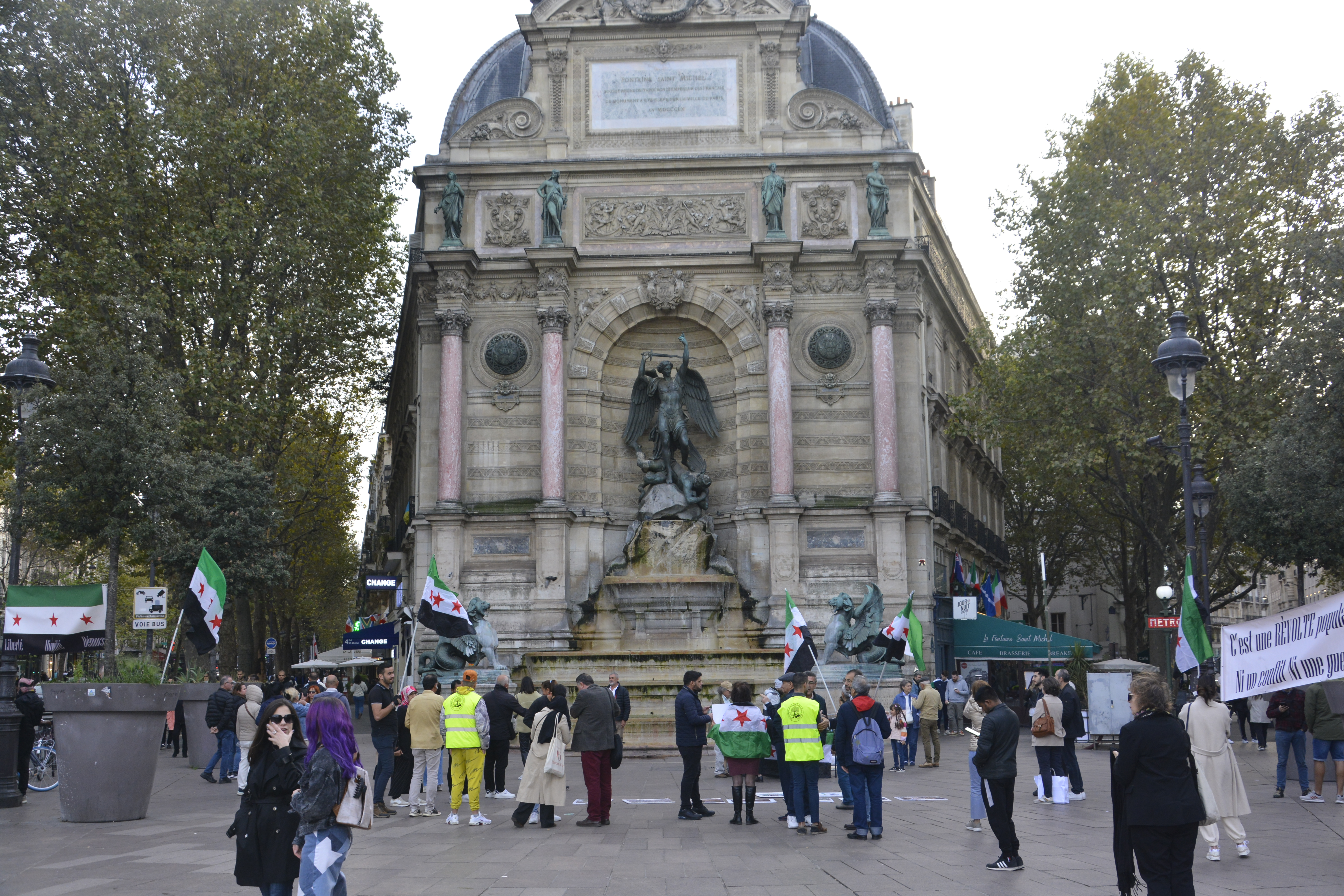
Syrians took part in a demonstration in Paris to urge the international community to hold Syrian war criminals accountable. (Photo by Harun al-Aswad October 15 2023)
Such news is highly sensitive, often provoking individuals to reopen mass graves, potentially damaging evidence while searching for the remains of their relatives.
Al Arabiya also claimed that the Syrian-British businessman Ayman Asfari would establish a new government, forcing him to issue a statement denying the news.
International spread
The channel further posted controversial details about Assad’s Syrian-British wife.
This details, based on a fake X (formerly Twitter) account and first published by the Russian broadcaster RT, was picked up by the Arabic versions of Sky News and CNBC TV, gaining thousands of interactions and prompting heated discussions.

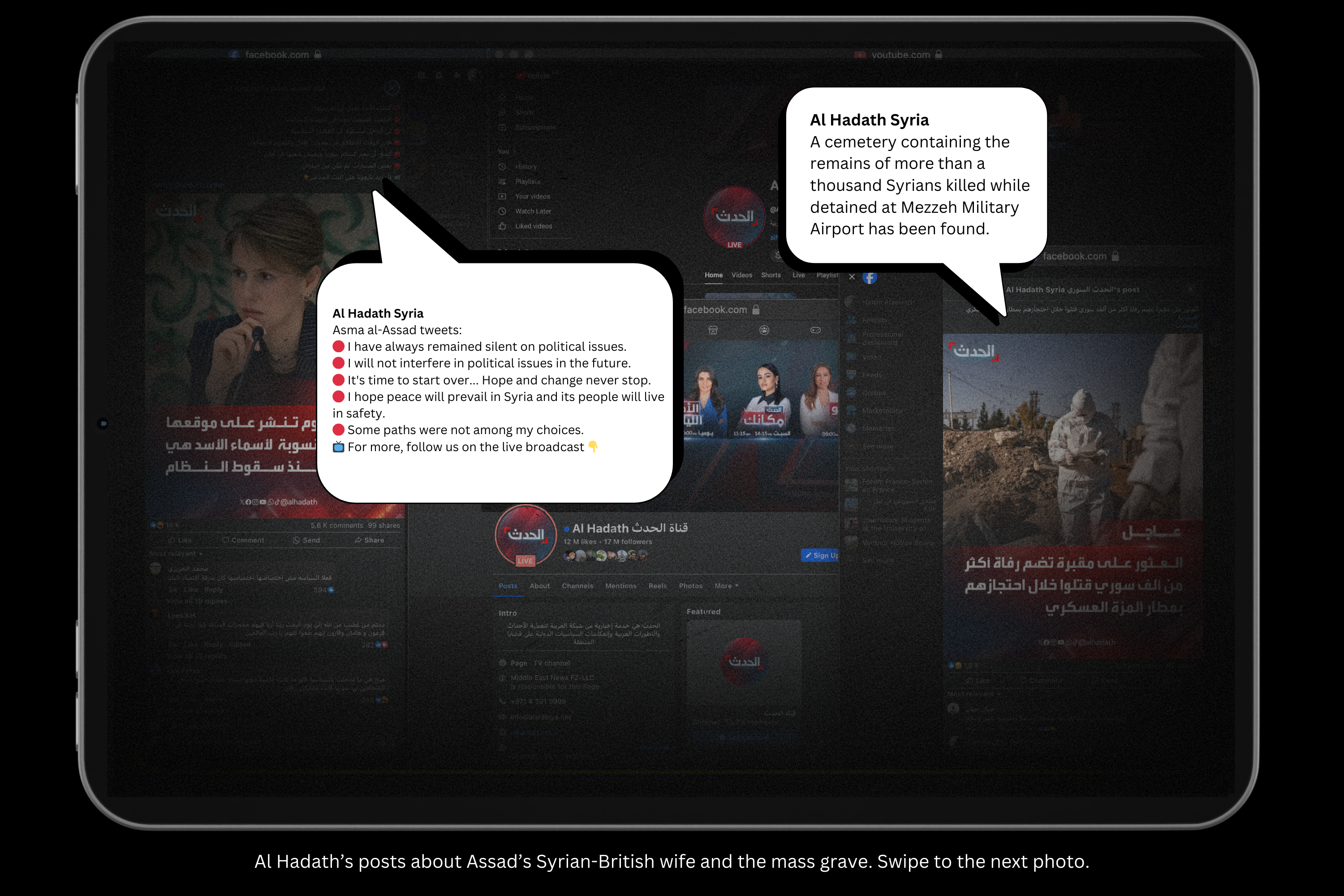
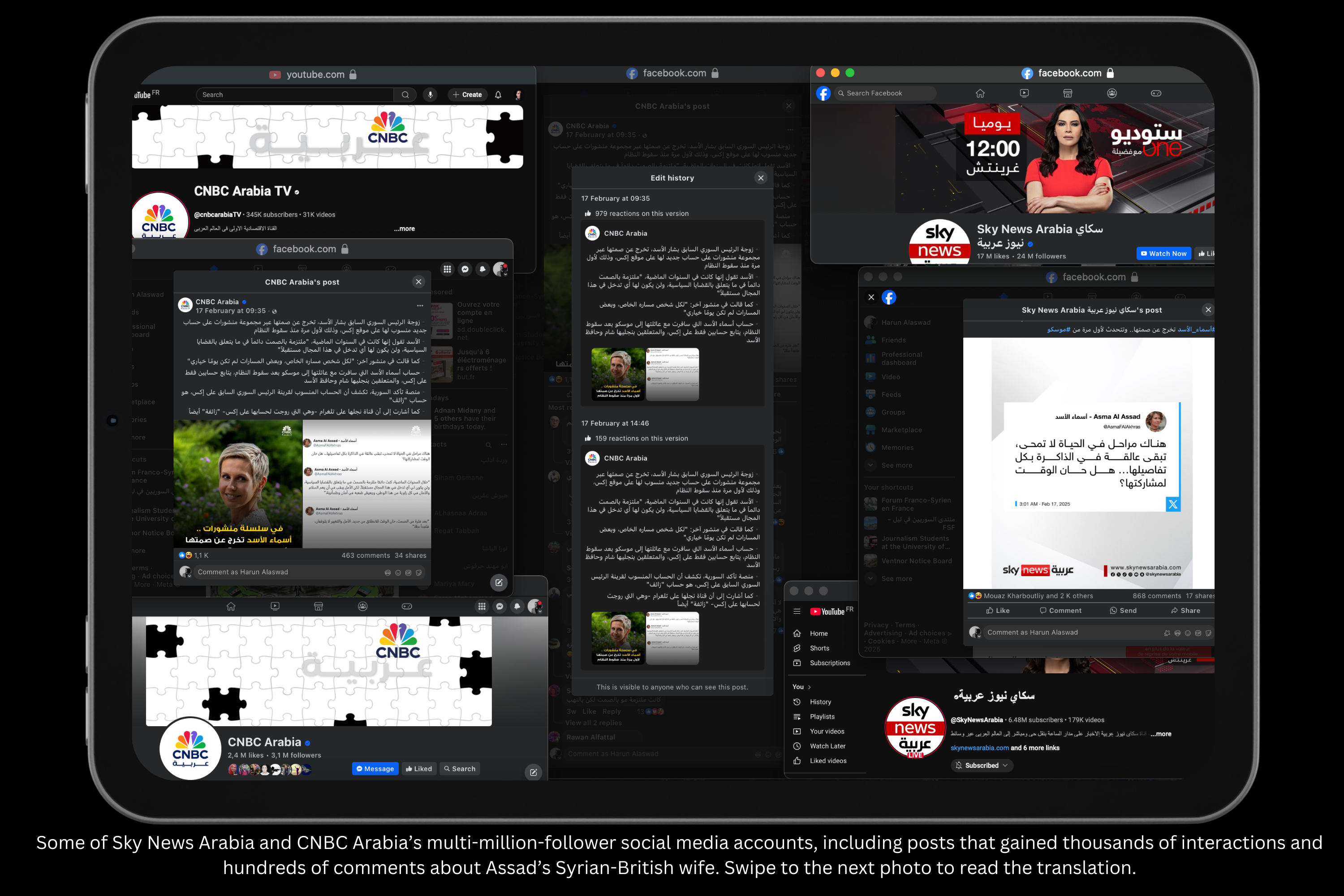
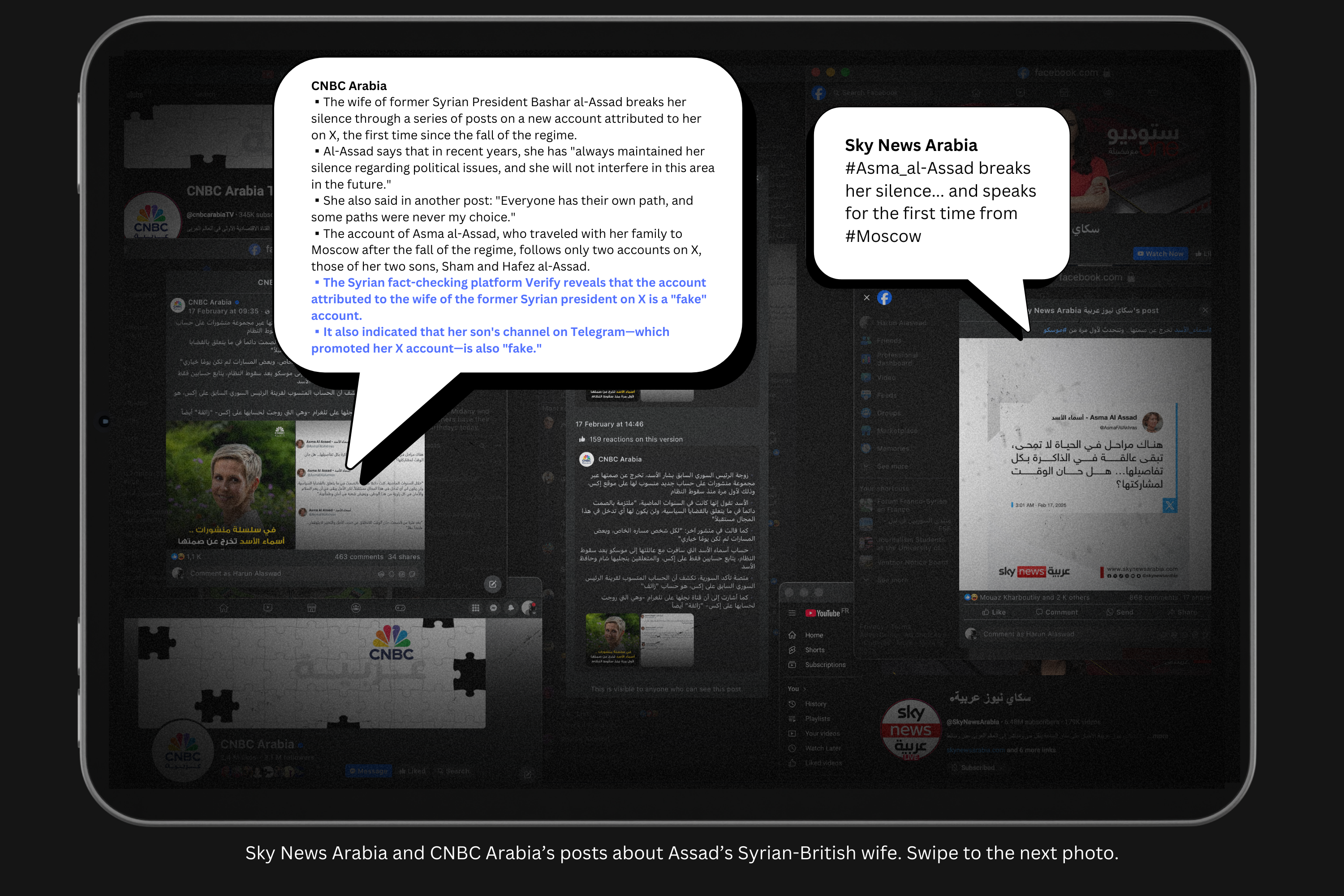

Screenshots and translations of two posts published by Al-Hadath, as well as other posts published by Al Arabiya, the Arabic versions of Sky News, and CNBC TV. Swipe to view the full album.
The three TV channels neither deleted nor apologised for the misleading content and did not respond to MEE’s request for comment. Only CNBC corrected its post.
Earlier, the fake X account, a Turkish site claimed that Assad’s allegedly ill wife was seeking to divorce him and escape Russia for the UK. This led a British MP to tweet that she would be prosecuted for aiding a war criminal if she entered the UK.
Q&A Who is Assad’s wife?
+ Show / hide
Asma al-Assad, a British-Syrian born in the UK, worked in finance before marrying al-Assad in 2000. She is accused of aiding her war-criminal husband and faces sanctions for supporting the regime.
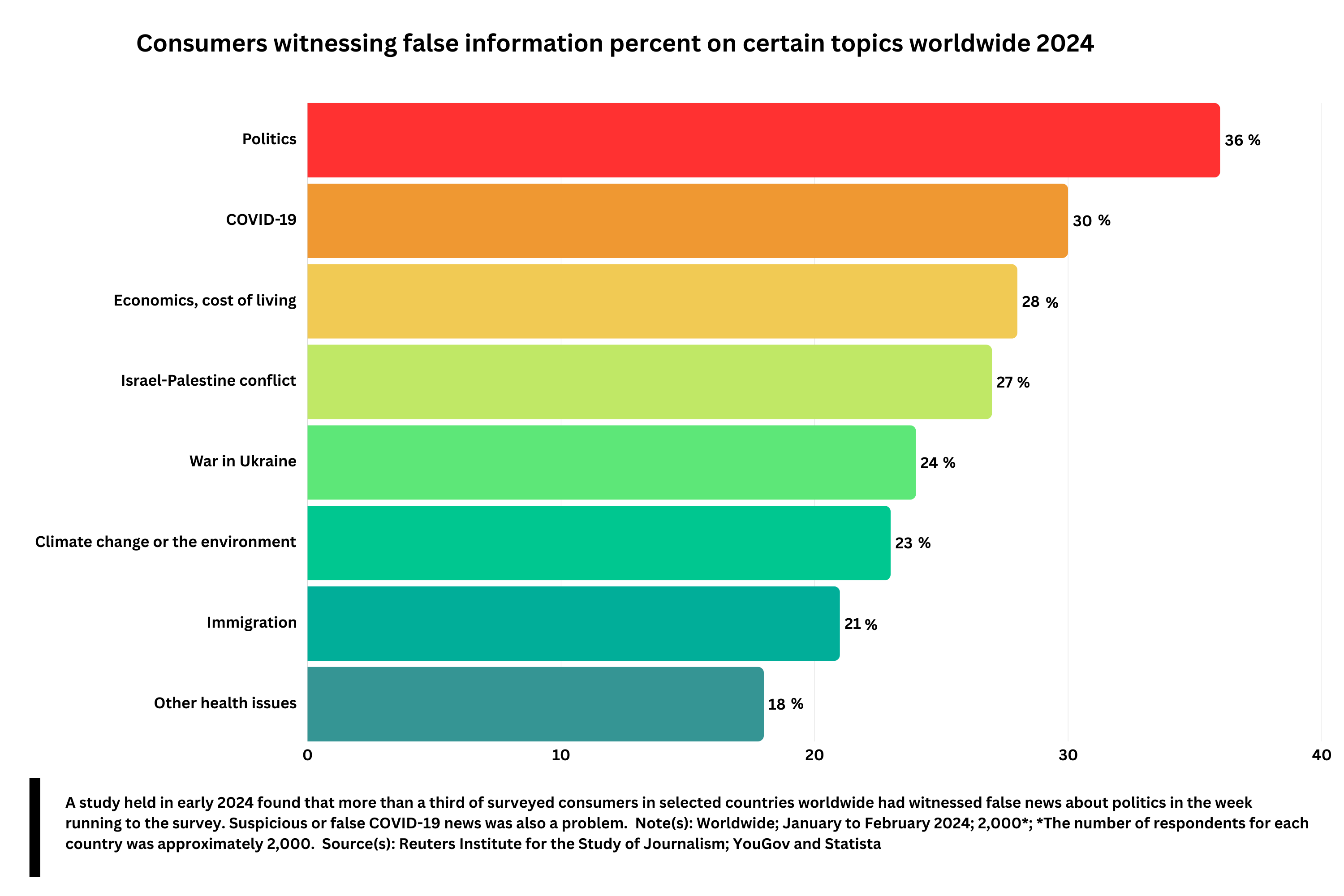
According to the Reuters Institute for the Study of Journalism, 63% of 2,000 news consumers worldwide have encountered false political information.
Ahmed Primo, CEO of the EU-based Syrian fact-checking platform Verify, told MEE that his team has identified and corrected over 3,000 misleading pieces of information since 2021.
He said that misleading news tends to follow “specific techniques”, often using key phrases designed to provoke suspicion.
“Excitement is one of the main tactics… It manifests in many forms, such as sectarian incitement or the amplification of specific stories,” he said.
He explained that the former regime’s media influence and the lack of official sources contribute to the proliferation of deceptive content.
Social media effects
“Each country has its own interest
[in finding local media], so even those
with access to television depend on social
media [Telegram and WhatsApp],”
– Imad Khalid Ismail, a lawyer
who participated in the MEE survey.
The government does not run a state television channel and relies on influencers, social media platforms, and messaging apps such as WhatsApp and Telegram to disseminate official news.
The accessibility of WhatsApp and Telegram—especially in areas with poor internet connectivity—along with the rise of frontline war monitors on these platforms, makes them the primary source of breaking news, often leading to a surge in misinformation.
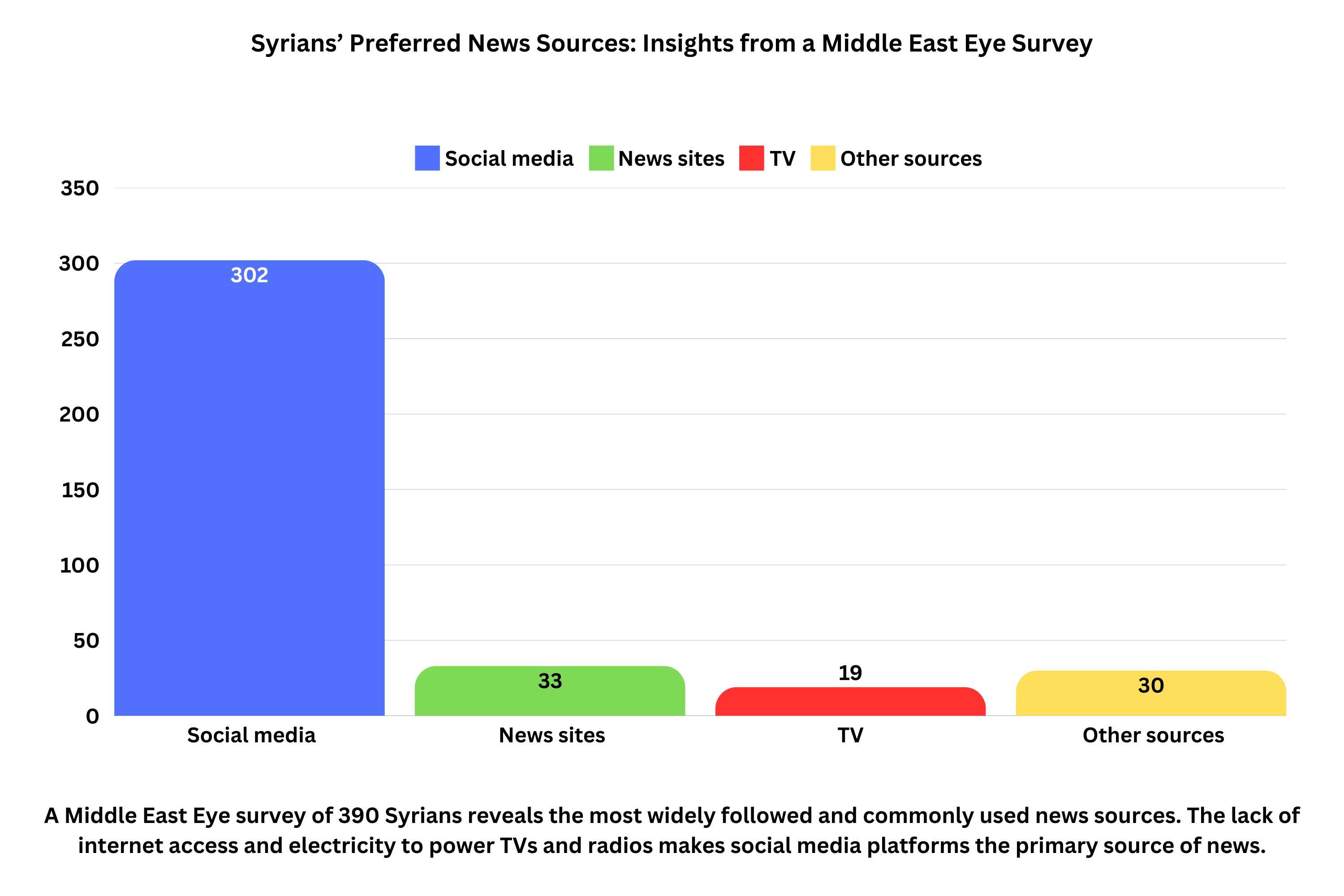
In a survey conducted by MEE with 390 participants, 77.5% said they relied on social media as their main news source, while 10% depended on news websites and only 4.9% on TV and radio.
Imad Khalid Ismail, a lawyer who took part in the survey, told MEE that people search for hope, and fake news sometimes appeals to them.
“People are simple… They find it discouraging to see complicated, politically irrelevant international news. The most engaging news is related to food sources and security conditions.
“Each country has its own interest [in finding local media], so even those with access to television depend on social media [Telegram and WhatsApp].
“Things will change if we get a trusted state TV channel that addresses public needs, services, and daily life,” he added.
This story is an MA Journalism assignment for the University of Portsmouth, UK.